Wahi gudegi kakalso, wahi gudegi kifate.
ah We're here on Warrior Saint and uh today I've got a very special guest.
have a very...
say an old friend of mine, but he's not actually that old.
I'm old.
And you can see from my beard that I've had a tougher go of it than he has.
You can see from his beard that he's had a pretty easy go of it.
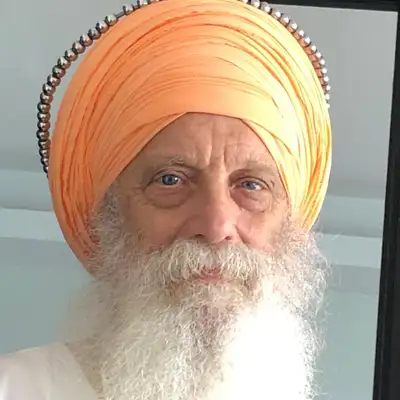
anyhow, the man's name is Hemmitsen Kalsa, and he's right now in, I believe in Arizona,
and we're...
As you'll pick up from today's conversation, we're really good friends.
We've known each other a very long time.
Our circumstances of our life has kind of put us in other directions, but we've stayed
tight and he's got a great family.
he always has very interesting ideas.
And I don't know where we'll go with it all today, but I'm sure I...
I hope anybody who's here listening to Warrior Saint today will stick in.
Sometimes it's tough to stick through a whole hour conversation, but this one probably
will be a doozy.
And I'm excited because I'll be disappointed if I don't hear some very visionary things
from this very unique person who I know.
We've known each other probably, what?
I can't believe it.
We've probably known each other what?
30 years, at least.
At least, no, actually, I've been married now 26 years, but I think we met a couple years
before even I got married, so I'd say it's hard to believe.
Yeah, it blows my mind that we've known each other for 30 years and we've seen a lot in
each other's lives, a lot of stuff, you know, a lot of.
challenging stuff a lot of a lot of cool stuff and and here we are 30 years later and and
he's done a lot of like really interesting things that I like to get into at some point in
the conversation but uh
that, I was thinking about it.
uh I think that you are the only friend that I've known that I stayed in contact with for
that long.
So, yeah.
be my only friend right now.
Yeah.
uh
I've worn everyone out, but you must have some kind of special stamina.
I think I've worn everyone out.
I'm trying to count my friends and right now I have it on one finger actually, so.
well, I'm not going anywhere you can't you can't scare me off
So, yeah, 30 years ago, we didn't know each other and he found himself in my place at some
point and I had the opportunity to share still lot of yoga, meditation, and stuff in
spiritual development that I had picked up when I was a little younger than he was at the
time.
And then...
We met each other and now, know, 30 years later from what I understand, you know, he's
sharing his own wisdom with people.
uh it's very pleasing to see that, you know, it doesn't always happen, but it's really
pleasing to meet somebody, you think you have some kind of positive effect on them and
then you can really see that it's the stuff gets handed down.
generation to generation and that's really what it's about.
So I'm excited to have you here today.
What do you have to say for yourself?
Well, I'm blessed I'm honored to know you of course and honored to be Invited to your your
podcast and as you said, I I hope to be able to share some inspiring Stories about my life
as I was saying before we came on quite honestly, I'm a fairly private person and This is
not something that I do regularly.
I'm not in any way an influencer.
I don't have a
platform.
I don't have an agenda in this call.
I'm a typical householder uh with a family that works and uh does their thing to keep
themselves spiritually uplifted as much as possible and try to share what I've learned as
I go.
yeah, uh so I'm happy to be here and happy to share.
uh We'll take the conversation wherever you want to take it.
You know, you mentioned interesting word because, you know, in any group there's kind of
like code words, code language, you know, and people in it have heard it, you know, so a
word that both of us have heard and used a lot is a householder.
And...
uh
I'm not saying it's, it's like, um, a manipulative agenda, but like, yeah, sure.
The name of the podcast is warrior saints for a reason.
Um, we never push in anything, but inevitably conversations kind of go in the direction of
a, a certain, uh, ideal, a certain like idealized concept of what
an ideal life is and, you know, the warrior saint thing, or some people say saint warrior,
there's not a whole lot of knowledge about this particular way of living.
um there's like every path, it has its own emphasis on things.
When I was introduced to this when I was younger, like, there was this uh great emphasis
placed on this word householder.
And not only by the people who were teaching me, but then the person who had actually
brought this to the West.
And then ultimately, I was...
kind of brought into contact with the original founders of this from three, 500 years ago,
you know, and you're reading this stuff from 500 years ago and there's a lot of talk about
this whole householder thing.
and how it's such a central tenant of this particular path.
when I got introduced to this, was 25, 24, 25 years old and now I'm 74, but I was, you
know, I was, that was 50 years ago.
And that didn't have much attraction to me, that tenant.
It didn't align with the...
any of my fantasized ideas of what it is or what it should be.
And it seemed actually kind of boring what they were talking about.
But now, yeah, of course, 50 years later, a very different view of that I consider it to
be one of the things that really kind of define this particular path is that the people
who take it on are really urged to be ideal.
householders, family, people contributing to the society.
So what's your experience of that?
Well, I was going to actually ask you uh if you felt that there was any conflict between
the concept of householder and the concept of warrior-saint, like the relationship between
those two.
I've been, I've been involved with this for 50 years and that's the first time somebody
actually asked me about that in 50 years, right now.
How do you basically put two things together that seem to be not the same thing?
Right?
How do you square the two?
And nobody's asked me, but that's like really...
I'm going on a tour of South America in about a week and a half.
And you could be...
damn sure I'm gonna talk about that.
You know, that's a really good, that's a real, you know, it's the same kind of thing.
How do you square being a warrior with a saint?
You know, because people just can't, I mean, they're thinking it's like this or that.
And then if you have this concept of it being a warrior saint being something, how do you
square that?
with uh being a day-to-day householder.
And I think it's one of the real challenges in bringing people along in this because um
it's really a challenge for people to work that out, not just in their head, but in their
day-to-day life.
And I think that a lot of people are just either unwilling or unprepared
to kind of understand how being a warrior and being a saintly person is all kind of melded
together.
And then you kind of have this idealized view of what kind of person that would be, which
seems like uh kind of an otherworldly person.
Like if you were living like a prototype warrior saint, you'd be living completely
out of the paradigm of an average person living in society, right?
So even putting the warrior and saint together, that's like, you're living at a certain
standard that the average person would have no intention of living, even if they admired
it on some philosophical point of view.
And then you're basically asking people to practice that as like an everyday householder.
That's like,
People have, I think, have a very hard time squaring it.
And if they're unable to do that in time, because everybody's got time, if they're unable
to do that, if they're unable to square it, they're gonna have to walk away from it
probably, because it's just too much.
So let's talk about that a little bit, squaring it.
You start talking about these words.
We have three words here, warrior, saint, and householder.
And so it starts, I think, with how you define those for yourself.
What is a warrior?
What is a saint?
And what is a householder?
So what is
good.
you know, again, I'm not like trying to evade anything, things.
I'm just trying to give you your props, you know, because, you know, look, I talk about
these things with people and, you know, thank God there's somebody like yourself who's
basically saying, you know, you define the terms of this engagement.
Okay.
Because you're just not going to throw words at me.
So like, what are we really talking about?
And again, that really happens very rarely.
So I really appreciate that.
And I think, and I ask people to do it and then they get mad at me when I do it, but it's
my right, right?
So if people are given a big philosophical discourse, it's my right to actually understand
the terms they're using.
If they're going to go out there rather than just paint a pretty picture with words, you
know, so
I think I'm trying in general.
I try to talk about the original origin of word.
Why literally it was born to be.
But I don't always talk about that, but that's usually part of that.
And then the other part of it is to try to articulate.
An understanding of it that.
anybody would understand that we're on the same page in modern society at the how it's
used.
Not how it's ideally gonna be used, but like how it's used in the society and then how it
applies to this particular situation.
Because again, you you're using words like warrior and that as they like to use the word
these days can trigger people, right?
People like the trigger word, right?
Right.
So.
at, this is a really important time in history, right?
In the Middle East and everything that's happening.
So the.
and people have, and people manipulate the words for their own gain, so they can make
warrior just mean somebody who's uh willing to die for what they want them to die for, you
know.
So they'll call them a warrior as a compliment, but then other people who look at it
differently,
a warrior to them is somebody who has license to kill.
Okay, and in all cases, that's to them a bad thing.
So the word starts getting loaded because people start using it and understanding it to,
in my view, to basically fit their own needs.
But I'm trying to...
I was gonna say one thing that's nice about this conversation around these three concepts
is that in this case, we're not necessarily looking at them alone.
You're not just a warrior.
You're not just a saint and you're not just a householder.
It's a matter of trying to hold all three of those.
And they relate to each other.
There's a strong relationship between those.
They support each other, they relate to each other.
So think that helps us to ground the conversation around these concepts to what I think
that we believe.
Yeah, and you I think you brought up a really good point in that, you know, when you
started about what do mean by you were like challenging me what you mean by that.
And I really haven't even gotten to the point yet.
But I'm not trying to be evasive either, you know, but it's it's the thing is, is I
actually really wanted to say how much I agree with you from my experience is that we're
seeing how those words play off of each other.
But
And you see people get into these types of conversations with the assumption that they all
agree what those words actually even mean within themselves.
And now they're trying to bring them together, but wait a minute, we haven't actually
agreed what they even mean within their own realm.
then within different realms, they mean different things.
I think for, we're buddies, we both.
kind of chose to walk on this path.
So we've heard it and I think it's an okay thing to do is that we're both followers of
Sikh path and particularly Guru Gobind Singh and the Khalsa message.
And so whether people agreed or didn't agree with the general definition of it, I think
it's productive for us to say
how it's being used in this context.
Okay, without making anybody right or wrong about a word, without putting any value
judgments on it, it's just what it is.
I think that when we talk about...
To me, and I'm interested in your viewpoint about this too.
And without us getting into like word salads, know, like getting into what a word means.
I think I'm interested in going, okay, a word represents something in my understanding
that I think is of great value, okay?
So without debating what a word means, I'm more or less using the word as a representation
of an ideal.
I think for us, a warrior is somebody who's willing to sacrifice everything if necessary
for a higher ideal, which I would call the mission, whatever they think the mission is,
okay.
ah And the betterment of other people, for the wellbeing of other people, for the
wellbeing of humanity, for...
the objectives of what they're committing their life to, that they're willing to actually
even sacrifice their own life and to do this, they are, they're aspiring to live without
fear.
That's what I would call a warrior in this context.
Yeah, I was definitely thinking of this idea because it's something that I can hold on to.
And it's also something that challenges me directly uh at times.
But the idea of fearlessness.
Now, ah again, you coupled it with the willing to sacrifice everything.
And so uh it isn't just fearlessness.
ah It is.
rounded out and supported with this idea of, okay, you can say all these things, but when
you're put in that moment, are you willing to sacrifice everything?
And this does begin to set up a conflict with the idea of householder and things like
that, because are you willing to sacrifice everything, including losing your family and
these types of things, which
right.
Right, and you know, I was waiting on that, because I think that's really an interesting
place to take this, okay?
But again, before going there, I'm trying to provide some clarity about what I'm talking
about before I jump into the householder, because to me, this warrior saint thing is a
package.
You know, it's not two separate things.
It's a merging of two ideals into one ideal.
And you really can't separate them, so.
So I gave what I think is a fair explanation of the warrior side of it.
Do you think that was fair?
I think that was fair, yeah.
It landed well with me, anyway.
Yeah.
know, I've gotten to that point too.
I'm not seeking a perfect explanation because the whole linguistics is another thing, you
know?
But I think what's most important is that there's an understanding, you know, where...
I kind of, the way that I sort of, let's use that square this up for myself, is that I'm
willing to continue to learn.
And I do think that our context is important in where we are in our life.
So I don't close the door on any.
definition of a word or what I especially words that we're talking about these words are
they're loaded and they're each one of them is an ideal that people spend lifetimes trying
to fully achieve and embody so uh Yeah, I'm open to continuing to expand my view of that
but I think that the way that you put it sacrifice and fearless sacrifice everything
willing to sacrifice everything and this idea of fearlessness, know, that's
the way I understand those, that word.
Yeah, and it doesn't actually have to mean, as you know, because we're concerned about in
this path also, you know, human rights and things like that.
fighting for those who can't fight for themselves, but that's not just physical.
So sometimes the warrior thing, people just think of carrying the sword, which we do, but
you can live like a warrior and should be able to live like a warrior without actually
having to pick up a weapon.
I mean, this is one of the great elements that has been lost in some Western yoga
practices.
I think this is a real distinction.
people don't, a lot of people who are practicing yoga, they are not connecting it with the
tradition that many of the people who are practicing yoga were also warriors, not just in
our path, but
traditionally classical yogis were warriors.
They fought and were prepared and they were the strongest in many cases of their tribe or
whatever.
um So yeah, there's a real connection and there's a disconnect, I think, in the modern
yoga world where people have a sense of what yoga is and they've disconnected it from that
idea of the warrior.
Well, and I think also that.
I think people are much more influenced than they're willing to acknowledge about how
things around them in the world, the secular world ah affect them because, you know,
people don't, I mean, when we talk about warrior, that implicates there may be situations
where there's violence and killing and suffering and...
just by the way we're raised and just how things are going on around us, that's very hard
for people to square.
How can you call yourself a spiritual or religious person, a God-oriented person, and even
think about harming a fly?
And so, but they've been conditioned to think that way without question.
And now, like even in this conversation, like it could be an uncomfortable conversation
for people is that you're questioning their fundamental belief system about things, about
what makes a person a spiritual person even.
So in this particular path, you talk about the warrior saint and I think actually the
other word, it would seem like the other way around, but I actually think the other word,
the saint,
is even harder to define.
It's much more abstract to most people.
And even if they were against it, they'd probably have an easier time trying to define
warrior than they did to saint.
And again, they're assuming everyone's on the same page, but maybe not.
And so in this tradition, I'm not talking about other traditions.
And I'm trying to just make it understandable is that to me, a saint, the same part of it
is really the devotional.
And so it's a person coming from a place of uh humility and devotion.
and all the things implicated by that, the love, the kindness, those kinds of things,
certain types of qualities that have to do with unconditional love and devotion,
especially to that force that brought us here as human beings that many of us would call
God.
ah That's kind of like the person, that's kind of like the same persona.
That's how I take it.
In fact, as you said, you went into a yoga class and you just, know, and I've done this,
you know, my style, you know, if you just like nail somebody in the middle of class and
going, what does being a saint mean to you?
You won't get a straight answer.
Cause they really have in most cases, give it any thought.
Yeah, yeah, it's a super strong word, and it has a lot of different implications.
uh I think that there's a sense of purity that is attached to that word as well, which
really makes it difficult to square, in some cases, the idea of uh the warrior and the
saint.
uh
But that's what makes, I think, whole discussion as well as this whole path, the Dharma,
so rich is that we should be taking these ideals that are really pretty much the, in each
area, they're kind of like the ultimate.
You have people who fight, you have people who are into martial arts, things like that.
And then you have the warrior, and the warrior is the ultimate of that.
particular path.
Then you have people who pray, they practice religion, and then you have the saint, which
is the ultimate of that.
uh Householders, same thing, same level.
You you have people who marry and or they participate, they have partners, they have all
these different things going on in their lives.
But I think for us, the household or someone who can balance all of that and be totally
immersed in the everyday life.
ah that would be kind of in many ways the highest ideal of living, but working, having a
family and all these other things.
Well, know, to me, you kind of answered your own question because you were asking way back
when, you know, like, how do you square out, how do you integrate, you know, being a
warrior saint, I mean, and to being a householder.
And I think I remembered saying that, you know, first, you kind of got to square away any
kind of paradox about being a warrior and being a saint at the same time.
that implicates uh really uh dedicating your life to being a virtuous person because
there's many core virtues involved that life gives you the opportunity to do it.
So, you know, known me a long time, so in my life, you know, I just see my entire life
just being uh like a battlefield or a playground or whatever you want to call it, a test
ground to get all this stuff together here.
And um actually this human life works very well as being the best place to actually become
a warrior saint.
Because you're being asked to do certain things.
So to me they're actually dependent on each other.
They're not exactly the same thing, but they're dependent on each other.
Is that if you're dedicating your life to
I'll call like the Kalsa prototype is to be a warrior saint.
Okay, that's the prototype.
uh Okay, so ideally a person is gonna use the life to better themselves.
So they're gonna evolve into the kind of person who really is a great uh model of these
qualities of being a warrior and being a saint.
at the same time to such extent that you can't actually divide these two.
But the thing about the householder is actually.
Now, having done this, I think a very strong argument can be made that living the
household of life is actually the best opportunity to master being a warrior saint, much
more so than, let's say, if you just were living in a cave or something meditating, that
that would help you in some ways, but actually,
Like what you're doing, working in the world, being a father, being a husband, being a
member of the community and all the pressures and, know, and, uh, hypocrisies and
everything that you have to deal with in day-to-day life, that, um, those are the things
that actually get your chops on.
that, that, that's, that you can look at as struggles and horrible things, but you can
also see it as that this is where you're really going to school.
And so I think that the household of life is actually, and I think the guru spoke of this,
is that the household of life is the best platform that one who's aspiring to be a warrior
saint can actually get this stuff together, doing it, that they couldn't do that on their
own.
yeah, I think that there's the possibility that when somebody hears warrior saint on its
own, that they may envision somebody who's out there on a horse training all the time for
battle.
And, you know, uh the idea that the warrior saint is somebody who is out there training
all the time for battle.
but is going home to feed their children and take care of their wife and take out the
trash, whatever has to happen that day.
uh That makes it, I think, actually way more palatable for the mainstream.
It's a way of life that supports you with these ideals, that helps to kind of
give you so you don't slip into complacency.
I mean, if you disconnect the warrior saint idea from householder, it could be very, you
know, uh you're doing what you need to do, but.
The spice isn't there, the passion, the fight, really the fight.
The fight can be lost and you see this happening with people.
And it's actually, um I know lots of men who they get married, they get their job and um
they're not out there on the hunt anymore and they get complacent.
They're not feeling like they have full life anymore.
They don't have that.
um that drive, but with the understanding that, uh you know, you're stretching every day
for these ideals towards the fearlessness, towards the willingness to sacrifice everything
for your values, your virtues, then uh how could you get bored?
How could you get complacent?
It doesn't ever stop.
It's constantly every day you're challenged and you're trying to meet that challenge as a
saint would.
uh Yeah, so I think it really builds in, uh you know, kind of the cherry color, the like
this idea that we're always.
Raise every morning we get up, we're raising for the challenge and we will make mistakes.
We're not perfect.
The idea of Saint, you know, it kind of has these connotations around.
perfection and all of this.
But uh I think most uh CALSA would admit to making a mistake here and there.
These are things that we stretch for every day.
And we move in those directions uh and try to continually be improving.
uh yeah, it's nice to I haven't really thought about these things.
And we keep using this word square.
I was thinking, we're really more talking about a triangle.
Being an architect, I'm really into geometry.
And so right now with this.
that.
definitely want to get into it.
I hope if not this conversation, another one, because I really want to get into that kind
of thing because I think that's really where you'll be blowing a lot of people's minds,
including mine.
think this is much more interesting.
ah And I think it's more appropriate for your podcast.
Because it's funny, uh we didn't prep for this at all.
And uh as an architect, I'm a planner.
I'm always, whatever it is I'm going to do, there's going to be a plan behind it.
It's just kind of in my DNA.
And so I had reached, I had.
when we originally spoke about the idea of doing this, I said, maybe I'll send you five or
so topics we could talk about.
And you were like, no, no, we'll just let it uh kind of manifest as it does.
And uh this has actually become, in my mind, a really interesting concept that I want to
think about, reflect on, write on, and consider.
uh
more in the future.
This has really become actually a really, I couldn't have planned this is what I'm saying.
Well, you know, and it's good because, you know, I think I was saying I'm going to be
going on a South American tour talking about these kind of things.
And you're bringing up some stuff that I I'm really going to have to remind myself to talk
about.
And and this thing because, know, it's really interesting.
I I do talk and have talked
a lot about this relationship between being a warrior and being a saint at the same time,
obviously.
But as I said, this other one's kind of interesting.
I haven't given it as much thought and I haven't talked about it publicly as much as like
the relationship between the prototype of a warrior saint and then the centrality of the
of the tenant of aspiring to be a householder, know, how do those interact?
I think that's actually where like the rubber hits the, know, the tire hits the road as
they say, you know.
And we talked about one side of it, which is, and I think it's a side of it that people
would talk about naturally is like that, okay, if you're aspiring to,
to have the virtue to live like a warrior and a saint as one integrated being that the
actual household life is a very uh really helpful and maybe perfect platform to perfect
that.
But then I think there's this other side to it that I was thinking about by something you
said, I forgot what it is you said, it made me think about because kind of in the other
direction.
It's that, okay, let's say that you're fairly evolved in what you're aspiring to be as a
warrior saint.
And as per your faith, you're living it as a householder.
You know, we all remember that the teacher, know, Yogi Bhajan, who was prominent in our
direction training within all of this, he was always saying,
I came to the West to create uh teachers, not students.
And for me, I always gave it a lot of thought, what does actually he mean by that?
And most of the people around me, from what I could see and what it meant to them, was
getting on a platform and formally teaching classes.
And I'm not denying that's not
a very honorable way to teach.
But to me, that never seemed like the whole enchilada.
To me, teaching people is a multi-level thing, mostly modeling a certain type of life and
inspiring people by who you are, but not just by what you say, but what you do.
And to me, um somebody could, I can imagine people I know saying to you,
when you're gonna start teaching.
And then me standing in a conversation and breaking out laughing, saying to them, someday
you'll teach like he teaches.
You know?
Because they don't understand is that you're teaching every single second of every single
day by choosing to actually integrate your warrior saint aspirations.
into daily life where you're having a tremendous effect on your family, your friends, your
community, your profession, you know, and the people to me have this very narrow view of
what it means to teach, but actually I think me and you don't see it that way.
We see it as actually being a household.
Right, as well as I'd say probably 80 % of the time uh that I'm working, I'm teaching.
mean, 100 % of the time, like I do, one of my profession, one of my professions is that I
do teach.
I teach yoga as well as I teach uh at a local community college in design and building
construction technology.
uh we satisfy it on both fronts.
And I was thinking to bring the element of a teacher.
Now we do have a square, but uh
Yeah, the teacher aspect of this, it's interesting because there's a lot of people that I
know that practice yoga and meditation and they're forever practitioners, which I don't
have anything against.
again, it was a kind of...
teaching of this Kundalini yoga or the Kundalini yoga path.
This is, how it relates to the voyeur Saint.
um These are obviously very related, but that uh that exact what you said that, you know,
you once you put yourself in the place of a teacher, now you have certain responsibilities
and it's just kind of like again, it's that
if you're, it's the highest ideal of that.
what you know and in your life, you gather information, you're a learner, and you're still
learning as a teacher, but at some point you elevate yourself to that ideal of a teacher
where now you're in the spotlight and people are gonna test you.
If you're a teacher, they're constantly watching you, they're gonna test you because if
they wanna be able to trust you and they're probably insecure in some ways,
And so you know that, everyone knows that because we've all probably tested our own
teachers.
So when you make that decision, okay, I'm gonna go from student to teacher, consciously,
you've leveled up.
You know you've taken on more responsibility.
Well, you you're bringing up to me how this works in two directions.
You know, like, who's getting what out of whom, you know?
So to me, you mentioned what I personally gained the most out of being in a position where
I'm viewed as a teacher and there are people who see themselves as being students.
don't naturally, it's not really my way to...
kind of really nurture that.
kind of point of view relationship because...
uh
Basically, um I've never thought I actually had one student.
I'm just me.
I'm just doing my thing.
And if people want to look at me a certain way, it's not me demanding it or me telling
them they can't or shouldn't.
It's really, none of it's any of my business.
My business is to run my own life, okay?
And I have to find myself on a stage sometime, but I'm always myself.
uh what I mostly get
Out of that, as you said, being in that role is uh I like being on the spot.
I like being pressured.
And uh because that's helping me develop as a person, that's my personal selfish view out
of it.
I know a lot of people like the adulation.
And you know, actually I do, I kind of, I enjoy it because everybody's telling you.
they, how great you are and they love you, you'd be a liar to say you don't feel anything
about it.
I don't think that's even honest.
But I think more importantly is you can't like it too much and you can't be dependent on
it for your own happiness.
You can't really give it any serious value other than.
uh
It's just entertainment and enjoyment and that's all it is.
And it doesn't actually help you become a better person.
what helps you become a better person is people challenging you and you come through
gracefully.
That keeps making you a better person.
And then it gets back to like what's really my role if viewed as a teacher.
And that is that they're helping me.
But it gets back to what we've been talking about most of this hour, and that it still
gets back to what you brought up.
I didn't bring it up, you brought it up.
How to do with this relationship between a warrior saint and a householder.
Because to me, I know that rightly or wrongly, and it's stupid to even get involved, if
it's true, it's not true, just rightly or wrongly, there are many people.
feel that I am a very good example of a warrior saint.
Okay?
And um I'm not into any debate whether it's right or wrong with people.
It's just, that's true.
Okay?
And so to many of these people, they'll like, they'll kind of acknowledge that I'm in a
place that they'd like to be.
Because they see me as being a warrior and a saint, and they'd really like to do that
themselves.
But they
feel it's out of reach to them.
So to me, the best way for me to teach them that it's accessible to them is to show them
that I'm a householder just like they are.
So in other words, I'm not living in another world than they are.
I'm living in the same world as they are.
And they could see that I'm even having a good time doing it.
I'm going to the beach, I'm going to a ball game, I'm going to a jazz club.
You know, I'm going to Italian restaurant.
you know, I, I, I'm following the news like everybody else.
I'm just a regular guy.
And so they're not understanding how can just a regular guy who's living like I am, is
married, he's got a job, he's a lawyer in my case, he's doing this and this.
How did he figure out a way to kind of live at that level of like spiritual immersion and
spiritual development and be living the same way I am.
So I think that's an invaluable lesson is that if I'm willing, to integrate my aspiration
to be a warrior saint into being a householder, just like everyone else around me and not
acting better or different, I'm just in there with everybody else.
It actually is probably the most inspiring thing to people because
it gives them the idea like, sure, I can do that.
And I think it's very valuable.
I totally agree with that.
And I think that it's always, we tend to do this as humans for whatever reason, is that we
see somebody who's living a life, living a life uh that we aspire to, but we idolize that.
We think, oh, well, he represents himself this way, but you know,
That can't be me because I've got this, this, and this.
And I would have to disconnect from that in order to fully dedicate myself to that.
And it's like, you can do that.
And it will actually help you to be happier in trying to do all the rest of the stuff.
They support each other.
permission.
If you're, basically you're doing it and you are brave enough to kind of be a trailblazer
in this, but you've never separated yourself from the same daily life challenges that
everyone around you is going through.
That's like a really gift you're giving to people.
It's not philosophy, it's not like an idea.
They can see.
They can see you're doing it so they know they can do it if they really want to.
They can't deny that it can be done.
It's not like a philosophical idea.
People are actually doing this.
And so I've really come, you know me, I've really kind of come to fall in completely in
love with this entire way of going about doing this, uh this life of aspiring towards
liberation in this lifetime and doing it.
This way, you know, when we met, was still practicing law in Oregon, you know?
And I was doing criminal appeals, which is uh really kind of a, it could be a dark place
to go, as you can imagine.
uh But without getting into the details, uh I landed up, uh you know, in the elevator one
day with one of the uh Supreme Court justices for Oregon, you know?
very well-known, highly respected person.
And uh we were just in the elevator and he said something like to me, hi, Harinam.
And my first thing, wow, he even knows my name.
You that's kind of cool.
I said, I haven't been in your court to argue a case in a couple of years.
I'm glad that you remember me.
And he says, remember you, everybody knows you.
You know, and I said, why is that?
I'm not the best lawyer in the world.
goes, everybody, says, he said to me something I'll never forget.
He says, everybody loves you.
Everybody respects you.
Even the people who don't, even he said, even your enemies, even the people who hate you,
they all respect you and love you.
And that blew me away.
And that was actually by a Supreme Court judge.
And I think the last thing he said to me was, ah he said, I really admire you, but I know
what he admires.
He admires that I am actually being a lawyer like every single other person in his court,
but I'm not afraid to be who I choose to be.
And everybody, he knows the difference.
He's sitting on the bench and he's seeing how people are pretending to be what they.
want other people to think they are or what they should be.
And I'm just who I am and everybody can see and I've heard this from other lawyers too.
I've had lawyers come up, lawyers I've never met in my life come up to me and say, I can't
tell you how jealous I am you.
So one really famous lawyer came up to me, says, I'm so jealous of you.
And he was serious.
And yeah, I said, why is that?
But I kind of already know, I wanna hear it out.
his mouth, he says, you're the only person I've ever met who does exactly what you want to
do.
Yeah, no, I'm so thankful for that.
I'm so thankful for that.
mean, the thing is, that uh unfortunately, a lot of people will not have that experience,
will not feel exactly like you feel right now based on, and you feel the way that you feel
because you've been willing to take those steps towards your own destiny.
And it's hard.
You've been challenged and it's not easy.
It's not an easy life.
It's challenging on all kinds of fronts.
And like I say, we make mistakes along the path, but there's nothing that will ever take
this away from you because you've had the feeling.
You know what it feels like to do that over the 70 some odd years.
It's a development and it continues to grow.
like the thing about the feeling is that uh your appreciation for it, your gratitude for
it.
is this is something that gets stronger as you go, as you get tested and you you
does.
And the tests get, really, they still are there.
we know people who've made the same choices that we have about where they chose the
trajectory of their life would be.
And some of those people are still around.
And on the outside, it would look that they're largely keeping to that.
But if you kind of dig a little deeper, you could see that people find a place where
they're comfortable.
And it's okay because they're at peace with themselves and they're comfortable.
But.
you find that they're lacking this passion you're talking about.
And that is, so basically to me, and you've said it in different ways, is like, the reason
that to me, they've lost their passion is they've lost their appetite for fighting.
Yeah, yeah, yeah.
they're basically got to the point that they just want to relax, but they didn't actually
make it to their destination yet.
And so deep down, if you talk to them, there's uh dissatisfaction.
I mean, I don't know about, well, I know you, but you do not want to lose your fight for
your last breath.
Your last breath, you want to have that sense of fight.
That's my belief.
And I think everything else is just preparing me for that last breath.
But that transition, you want to have the fight in you.
Yeah, and the only way you do that is if you start to develop an attitude that every day
you're living is really is could be your last day and be in reality about it.
So give every day everything you have because you may not have tomorrow.
And so it's a different way of living.
And I think you're well on your way here.
I mean, I've just seen a lot of
people around me kind of lose the dog in their fight, so to speak.
And if need be, you gotta do it yourself.
can't depend on other people.
I tell you, this has been, I'm just so happy that we, I don't get to talk with somebody
every day like this.
And I'm really wanting for us to talk more about
what you're doing in your day-to-day household life, especially your professional life.
I really want to hear what you have to say about your adventures in serving humanity
through designing spaces to work and live.
And I've had some of the most interesting conversations in my life with architects.
Yeah, and...
And a lot of them hadn't talked about it before, but they were all like gems if you really
kind of open up that oyster, you know?
There's pearls in there, right?
And uh once they start opening up, you realize, my God, there's like, uh there's a
treasure trove of visionary wisdom there.
Almost every architect.
And the people who don't have that eventually leave the profession.
That was my experience.
Because they, like a lot of people, were hoping it would make them happy, but they're not
happy because they never really embraced it.
oh Yeah, I mean in the end.
ah The outward manifestation of it is the building.
um
The depth of it comes from the space inside that and the process of getting there.
ah I think those are the things that are really interesting.
My own practice, we'll get into, yeah.
All right.
common human expression.
And you got to put up one thing and two and you go hold that thought, hold that thought
because that's going to be like an entire episode is just you, you know, taking us on a
tour of the geography inside your own head.
about uh what we're talking about now, because that's really something I'm excited about.
But landed up, we talked about our lives as householders.
I really am thrilled to death just having more than anything, know, just having an hour to
talk to a kindred spirit.
Sometimes it's a little lonely slog out there and it's so uh reaffirming to me to
talk to somebody who can really understand it from their own experience.
So I really thank you for that.
Well, thank you.
I respect you.
I'm like those other people.
I respect you a lot.
ah were the minister at my, you introduced me to my wife, I should say.
You were the minister at our wedding.
You're the godfather of our children.
You're my spiritual teacher.
And I am so thankful for the life that you've lived.
It's been a great example.
And it makes it real, all of this that we're
we're aspiring to be.
So thank you for having me.
Can I can I put that on my tombstone?
That's that's uh
I give you permission for that.
it.
Thank you very much.
I'm gonna say goodbye.
But basically, all you've done today is ensure that you're gonna be invited multiple times
as we go forward.
So you just earned yourself a right to do that.
That's really good because you're paying me a lot to do this.
You're right.
That's why I'm making the big bucks with this podcast.
All right.
Well, listen, God bless you and give my love to your family and everybody else.
And we'll be doing this again.
It's, uh you know, as always, uh the talking to you time just flies.
Oh, as always.
All right.
Well, God, all right.
God bless you.
bless you.