Alright.
All right.
And as we would say, and people are going to be hearing from us, uh Waheguru Ji Ka Khalsa,
Waheguru Ji Ki Fateh.
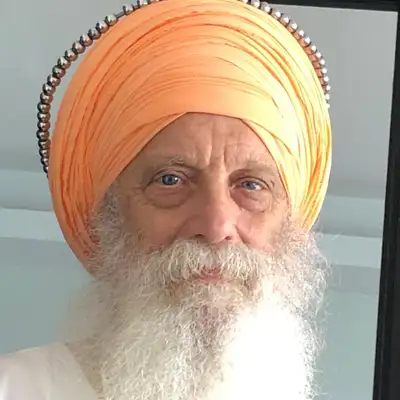
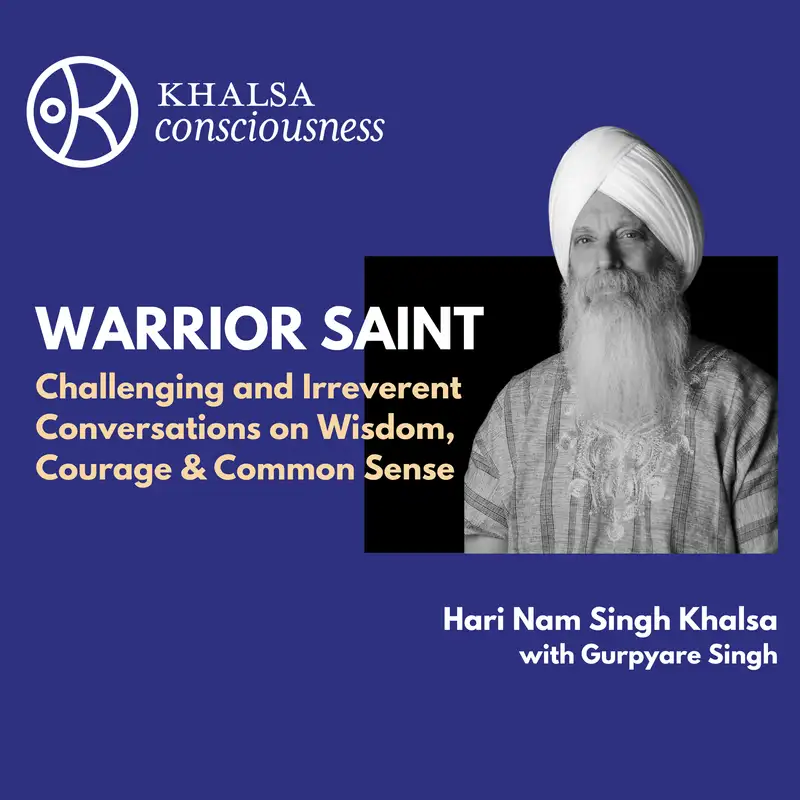
ah I'm Hari Nam Singh Khalsa.
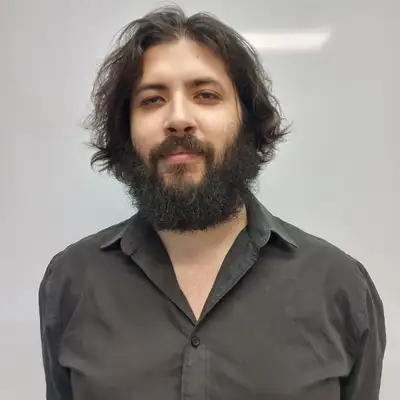
I'm with Gurupi Hari Singh.
And how you doing today?
How you doing, buddy?
I'm doing pretty good, good.
had a nice nap earlier and I ate a very big lunch so I would say that this is pretty good
day.
What about you, sir?
Well, you know what?
You're in Argentina.
I'm in Mexico.
You're four hours ahead of me.
So I um haven't even had my morning cappuccino yet.
that's that.
ah But it's already a good day for me because uh this is uh actually, for anybody watching
this, this is actually our first contemporary episode.
of this video podcast or audio podcast, depending on the how the audience is digesting it
of a Warrior Saint.
And so this is, I'll even say this December the 16th, 2025.
So this is a auspicious day for the two of us and our audio.
You know, I think I'm sorry to interrupt you there, sir, but I think that it would be
interesting to know for our audience who is watching or listening.
ah Why is it that this podcast is called a warrior saint?
Why that title exactly?
Yeah, well, um...
Well, first of all, uh let me give you a little history on that because I think that'll
give it some context and then we can talk about it because I think this is very big topic
itself, why this podcast is called Warrior Saint and people may have assumptions of what
that means but let's set it straight for the record, right?
By the way, I think...
I think there's some wind I'm hearing, but I don't know whether that's from me or from
you.
not catching anything on the Oreo on my side.
what?
think that, and I'll cut this out.
This is an example.
I'll just cut these couple of sentences out, but I'm hearing something, but it may be my
AirPods.
That's possible.
Okay.
All right.
We back.
All right, yeah, yeah,
Okay, we're good.
I'm gonna wait till you come back.
I'll just cut that out.
Okay, great.
So actually the history of this goes back to I believe 2012.
So 13 years ago I was living in New York City.
and I had been on, I was invited as a guest on a radio show.
I think talking about yoga, meditation, life, I don't recall exactly, but those kind of
things, philosophy.
And it was on some national network.
And the woman, and I believe her name was Fanny Cohen.
I never met her before, but she was kind of interested in some of the things I think I
said in the interview.
And she was kind of...
I guess in the pioneering movement of what we know now as podcasts when that just was
coming into being and she must have been about 30 at the time.
So she was a young person, I think who had an interest and an affinity towards not only
the technology, but kind of putting different kinds of material out in the public sphere
that had just been on the major networks or whatever.
So she was, think, kind of pioneering in this.
She invited me over to her studio and she asked me um if I was interested, that she would
be interviewing me.
Right.
And she asked me what I wanted the name of the podcast to be.
And I said, well, the first thing that came to my mind was Warrior Saint.
And the reason I said Warrior Saint is that, I mean, as you can see from my appearance, I
have a little bit different appearance.
um
I'm not only a member of the Sikh religion, which you could see from my beard and my
turban, but those in the know also can see from my appearance that uh I'm something known
as an Amrit Dari Sikh.
So I'm uh very loyal to a particular uh clear view of that tradition.
And uh the thing that is personally the center of my life is uh
an ideal called the Khalsa that was developed by a brilliant and saintly uh man called
Guru Gobind Singh who lived 300 years ago, who was the 10th in the lineage of the Sikh
Gurus.
we'll talk about that obviously in more detail at another time.
It's too interesting.
But let's just say that uh
I consider myself a disciple of this great saint who lived uh centuries ago.
And I really came to feel that his worldview, his recipe for person attaining liberation
this lifetime really resonated with me.
this was many, many decades ago and I devoted my life to that.
And there's kind of a...
a prototype of somebody who identifies themselves as a Khalsa and aspires to live the
ideal, prototypical life of a Khalsa.
And that has always been described in English, obviously they use another word, another
culture, but it really means warrior saint.
Some people say saint warrior, but I usually hear it as warrior saint and
What that prototype is in the end is the kind of person that somebody in this path would
aspire to be.
And that is ah both a warrior, somebody who is fearless in every way, who basically uh
lives their life intentionally with the highest character and um lives a life of service
and
just basically a very noble person.
again, we'll talk about this in future podcasts, but basically the warrior side of it is a
person who lives without fear and who lives a virtuous life and a noble life, and that's
their intention.
That's the warrior side.
And then it's not, but it's not just a strong, fearless person who's got very high
character.
There's the other side of it, which is the saint.
And that is the person who is loving, comes from their heart, is uh sweet, tries to treat
everybody with love and respect.
And it represents kind of like the sweetness of this.
So somebody who aspires to live in the way that Guru Gobind Singh has directed them to
live, to live the...
ideal human life and to achieve life's purpose.
ah That prototype for a man or for a woman, it's the lived life of a warrior saint, a
strong, fearless, high character person who at the same time is absolutely loving of all
humanity considers everybody their brother and sister.
So that's the prototype.
that's always been.
That's always been central to this whole cults ideal is this prototype that we strive to
live towards, which is been most often described as the warrior saint.
so in other words, so that is why, and that's the driving force in my own life.
And that's why I asked that the podcast that I did with Fanny back 12 years ago would be
called
what you're saying.
And, and so in the end, uh
I was hoping that any conversation she had with me would be an opportunity directly or
indirectly to kind of represent the kind of person who aspires to be that kind of person.
Hopefully that makes sense.
Yeah.
And you're learning a little about me too because we've known each other a long time, but
I haven't talked a lot about those things with you.
I don't think.
Some of the background in this.
So, you know, I would like to say here, because as you say, I am somewhat familiar with
these concepts, but, you know, for the sake of drawing some comparisons that might be
useful to our audience, would you say that there is a parallel between the Sikh warrior
saint philosophy
and something like say the Bushido code from like samurai Japan like we're talking about
this mix of like as you say not just preparation for life's hardships but also there is an
implied code of conduct to it as well.
yes, absolutely.
absolutely.
And I think that, you know, as you say, the the cults have often been described as the
the.
What was that group in Japan that I think the...
Wait, what is the uh samurai?
The samurai.
Right, right.
So the Khalsa have often been described as the samurai of India.
So I think what you're saying is true.
But you see these things actually in world, in a lot of things that have popped up around
the world.
I am familiar with...
the whole idea of Excalibur and the Anglo-Saxon culture.
so these attempts at living at a certain ideal have, I think, been universal and expressed
in different ways.
I think that the way that Guru Gobind Singh did this was especially effective and it sure
had an effect on me.
But yeah, that's for people who are new to all of this.
Yeah.
think that's a way of you're probably more familiar with the samurai than you are with the
Khalsa.
But very, yes, but very similar, basically skilled in martial arts as the Khalsa is, ah
following a very clear code of conduct, noble conduct, that's also very true.
And also at the same time, ah especially with the Khalsa, uh
coming from the heart and uh coming from a place of loving kindness.
that's a very important piece of it.
That's it.
So it's not just warrior.
It's not just the saint.
It's the saint warrior.
And so that's the that's the that's the concept and that and and that's the reason that I
initially got involved with this uh podcast 12 years ago and then kind of
And then it kind of, and we go back to that in a few minutes, but it kind of lay dormant
for about probably 12 or 13 years.
And then this year I had the idea, let's revive that podcast because I was listening to
it.
I'm like, hey, this is pretty darn good.
think now it's even more relevant now than it was 12 or 13 years ago.
Now's a good time, so let's rebirth it, right?
There you go.
Yeah, I would say like right now we are living in the era of podcasting.
So we're right on time here.
And another thing that I would like to ask you related to this, which I think would be
very much of interest to your audience is because of course you speak of the Sikh path and
its ideals and its goals.
uh
But I think a lot of people will be very interested in hearing how you came upon this path
in particular, like how did you happen to get to a point where you thought, okay, this
there is this uh Indian born philosophy that I feel particularly identified with or
attracted towards like how did that happen?
Wow, well, without like dodging that question, I would say that this is something that I
think the two of us are going to have a lot to share in the coming uh weeks and months and
years to really dive deep in that because that's something that's hard to say in five
minutes.
will say this though, for purposes of today's
Broadcast introductory broadcast is that I was first introduced to that I'm 73 now and I
was first introduced to this when I was 23 or I say 29 20 I'd say I was first introduced
this I'm sorry when I was 25 and I made it I started on my life of commitment to this when
I was 27
Okay, so that was like 50, more or less 50 years ago.
And so that I will say for purposes of this broadcast is that I wasn't born into this.
And in fact, back then, and we can talk more about it in the future, I was, I think I was
a hippie back then.
and I was living in a very different time in the United States.
And a lot of stuff was going on then that caused me to come into contact with this.
But at the end of the day, I first came into contact with this, something I had never
actually had any idea existed when I was 25.
And many of these new ideas completely blew my mind.
And it took me many years to really integrate all of this to really understand it.
many, many years.
And going kind of back to the podcast by the time it's 12 years ago, okay, I'm around this
almost 35, 40 years at that point.
So I had already had, uh you know, interjected this into my life and uh somebody heard me
talk about it and was interested enough that they wanted to host me on a podcast 12 years
ago.
And, and
Here we are.
But no, I'm not dodging your question, obviously.
That's a dive deep conversation.
But it happened almost 50 years ago that I was introduced to this.
And as you say, it was not an overnight sort of thing, it was like an actual process where
you sort of, we can say you progressively came to understand the thing better with time
after having already dived into it, does that make sense?
Yeah, after or thinking that I was diving into it.
mean, I you know, you know, because, and again, we can even talk about your life and
further sessions.
But a lot of times we, we think we know what we're doing.
But then we're doing and we realize we really only understand a portion of it.
And then we have to digest it.
Like, like, okay, I like even being married or anything, you know, you make a big decision
in your life.
and you're very passionate about that in the moment, but then it's like, my God, what did
I just do here?
All of the implications come into play, yeah, yeah.
Yeah, yeah, so then you have to kind of digest what you did and then you realize that, my
God, I'm just like an absolute beginner in this and I don't even know what I'm doing here.
But that's, you know, it's part of any big decision in life.
So yeah, so I made a big decision and yes, you're right, think it took, in fact, I'd say
it took me decades to sort out that decision.
And even at 73 years old, I continue to be surprised on how many dimensions of it exist
that I didn't even know existed yesterday.
So uh it's a never-ending oh learning experience, that's for sure.
You know, this leads me to another point here, which is...
uh
because of course this is just to give us like kind of a practical viewpoint regarding you
know the seek lifestyle and things like that but what were for example some immediate
changes in your lifestyle or behavior that you had to implement as a result of going like
okay I am going to be a Sikh now what does this imply
wow, well you know group PR, I'm gonna dodge that too.
I'm gonna dodge that too because...
But like what you're doing by asking these questions.
is just, and I hope anybody listening to this can understand this, is an example.
that people don't even know what they're getting into sometimes, even asking these
questions, because where do you even start?
These things are like so deep.
like, what are the changes in my life and what I mean?
Whoa, mean, I mean, we're gonna have podcasts that last for an hour that I'll probably
talk about just like, one thing, one change.
was, okay?
But I think, again, this is uh our first maiden voyage, so to speak.
And I think what I do like is you're asking me about why is this entitled, Where You're
Saint, and what does Where You're Saint mean?
think that, uh okay.
And also, uh
what we're trying to accomplish here, what I'm trying to accomplish here.
Okay.
And, and how is that tied into the name and, and the format of what we're doing?
Because I think in future, um, podcasts, uh, we're going to explore all these things in
extreme depth, uh, without necessarily lecturing anybody or telling anybody trying to
persuade anybody about anything.
ah We're just gonna open up just a dialogue that naturally we will be talking about all
these things because of how they affect our day-to-day life and the day-to-day life of our
listeners.
Right, right, right, right.
I can understand that.
Well, that being the case then, I am going to go in a pivot in a slightly different
direction here.
And I'm going to go back to the warrior saint thing, because I think there is a lot of
depth to be found there.
uh I'm very intrigued by the term warrior saint, because it implies a kind of balance just
from here.
Why do I say this?
Because you have the warrior on one hand.
First thing that comes to mind when you hear the word warrior is strength, courage,
resilience, know, steel, that sort of thing.
Then you have shame.
And then you associate that more with things like compassion, spiritual insight, love for
the people around you, know, doing things from the heart, as you say.
So there is a kind of like self-balancing act in the idea of the warrior saint.
Like you have someone whose strength is tempered by compassion and whose compassion is
sustained by strength, essentially.
Like does this make sense what I'm trying to say here?
Wow.
I think that's about much.
You know what?
uh as you, you, you know, you know how fun I am about you and the way you articulate
things.
And I would say that you did a much, much better job than I did explaining this because,
uh, I was listening to how you described it and I'm going, yeah, that's the per, that is
absolutely the, what
the inferences.
And I think you really captured it extraordinarily well with your words, much better than
I did.
Although I'd offer one other thing though, and this has to do with my own kind of
evolution and my understanding of it, is that if you had asked me 40 years ago, 30 years
ago, maybe even 20 years ago,
uh what this meant having these two words in juxtaposition to describe a person's uh
prototypical ambition.
I would have actually agreed with all of that, but I think actually what you described
from my own experience
is more of a reasonable inference that people could take.
Okay?
And not being untrue either, but I think my view of those two words now is different in
that it's not an equilibrium because they're really not two separate things.
It's more of an integration.
is that they, it's like water, it's not like, it's not like people have this conception,
which I think is the same thing, know, yin and yang, you know, that kind of thing, like
they're somehow paradoxical, uh they're paradoxical opposites, okay?
oh Okay, that somehow dance together to create something.
But in time, I realized that actually they're the same thing.
That oh as you would say, strength and kindness are not opposites that are in balance.
It's actually more subtle than that.
They're actually the same thing, just expressing themselves in different ways, but they're
the same thing.
They're blended.
And so,
The idea eventually that I came to learn is that it's not keeping my life in balance.
I don't think that's what the gurus meant by, and again, only they know I'm not claiming
to be the guru, but I don't think that they meant, although it's represented that way, but
I think it's much deeper than just merely that this is some kind of uh equilibrium balance
between two opposites that...
happen within a person because I've come to see that really what we're being led to is
being led to being a very unified person that we're not two separate parts.
just one person.
We're one being and that is it's like water and water.
It's an integration and that in the end it's since it's it's since it's a total merging.
and union and integration, you really can't separate these things.
They're the same thing in the end.
And that one of the things we're aspiring for is to see, you see that duality and you're
trying to bring it into harmony, but actually you're hoping in this lifetime to get to the
point that there is no duality at all.
It's just one thing that you're emerging of these two things.
And so that has been my experience, my understanding about that term, what you're saying
for that reason has changed.
very fascinating because um I want to bring up a little bit of Sikh history into this.
I'm not going go into it super in depth because we could spend like five episodes just
talking about Sikh history and it wouldn't be enough probably.
But this makes me think of how uh the lineage of gurus in Sikhism starts with a man of the
caliber of Guru Nanak.
who was pointedly not a warrior in his time.
uh He was more so, I would say, I don't want to use the term traditional, but for the sake
of practicality, could say more of a traditional spiritual leader.
ah And then throughout time, the lineage transmutes and evolves into a lineage of war, of
like,
warrior spiritual leaders without losing or changing any of the focus on compassion and
sainthood that already existed.
Like this is kind of what comes to mind.
it was integrated into it, as you say.
So like one thing was changed for the other.
It simply began to express itself in a new way.
Would that be accurate to what you're saying?
yeah.
And again, I like the way that you articulate things because the word that I heard coming
from you was expression, you know, and so it's how, so it's the same consciousness.
So this is why this is really what I think we're trying to do in this podcast too, in the
end is that we're trying to bring to people's awareness, the existence of a certain
type of consciousness.
Okay, we're not trying to convince people about anything.
We're not trying to we're not trying to convert to anybody to anything.
It's nothing like that.
We're trying to just bring to people's awareness of the existence of a certain prototype
of consciousness that has never actually changed as you said, I mean even from the founder
down it just
It has expressed itself in different ways as circumstances have dictated.
But it's the same, it's exactly the same worldview.
And that worldview gets expressed differently depending on what's going on in the world at
any particular time.
And so it's a state of mind, it's a state of being.
But there, it's, and we're really hoping.
I hope you're on the same page with this is that we're not actually going to be
intentionally having a philosophical conversations about the meaning of life.
We're probably going to be having conversations about day-to-day life, you know, and
what's going on in the world that we live in on a very pragmatic day-to-day mundane way.
how interesting it is dealing with human beings and the challenges that human beings have.
And I think somehow tying it into kind of a very simple way of tying all the loose ends
together.
uh How it all kind of, it doesn't matter what we'll be talking about, it's gonna be
bringing us back to the same place, which is.
uh Why is that true?
And is that congruent with why we were put here or is not congruent?
And if it's not congruent, what can I do in my life to kind of get me back on track?
So it's basically conversations about all the interesting things in people in life.
But in the end, it's about people.
It's not about like a theology.
It's about, I foresee our conversations are gonna be about uh curiosity, about things and
the things and people that uh inhabit the world, including our own lives, and seeing how
that matches up to that prototype without trying to convince people of anything, just.
I think we would be doing the best job in our podcast instead of telling people what we
think and what our opinion is, you know, and trying to convince people that we're right
wrong is that I hope that our conversations provoke curiosity and enough curiosity that
people aren't going to sleep at night after hearing the conversation and not that we're
like suggesting that anybody's right or anybody's wrong, but kind of having people think
about these things and how it affects their life and maybe open doors about the existence
of things that they didn't even know existed.
So I think that would be, you know, and like you were saying, like this is a good example,
like you're bringing up about
the warrior saint about how this would be equilibrium.
And I'm suggesting maybe even more than an equilibrium, that it's more about uh like
seamless integration, okay?
And it's not that anybody's right or wrong, it's just that it's a really interesting thing
that can be looked at at different angles and...
I'm hoping that just us talking about these things would give reason for people to
actually think about it in their own life and decide for themselves rather than be told
this is how it is, it's not, because I could do that if I want to.
I was trained as a lawyer, But I'm not wanting really to persuade as much as I am to
introduce people.
to new things and give them the opportunity to open their own minds and reach their own
conclusions with it.
Like, for instance, ah on this thing of uh integration, I'll give you an example.
uh So we often talk about the heart of a person.
That's very common.
We talk about a person's heart.
But it's really interesting because when we talk about
a person having a lot of courage and a lot of character and a lot of uh strength.
The term, at least in English, you hear most often is, hey, they had a big heart.
They have a big heart.
They've got a huge heart, which means they're very courageous, they're very brave, they're
very selfless.
You know, they're very strong, they've got a strong character.
Yeah, they got a big heart.
But also, people who are uh very kind and sweet and loving and compassionate, same thing,
people say they have a big heart.
Okay, but there's no accident because from my experience to really have a huge heart, you
have to have both, not one.
It's not enough just to be loving and compassionate.
It's not enough just to be strong and courageous.
If you're really talking about what
a big heart represents, it's all at the same time actually.
It's like, it's not even serially, it's like at the same moment, how can you be like the
most courageous, strong person under any circumstances and still maintain your kindness
and sweetness?
That's a challenge, that's very hard to do.
So I understand people could do one or the other.
But Gudegoban Singh in talking about the warrior saint, far as I can understand, is trying
to let us develop in this lifetime the capacity to have all those qualities all at the
same time.
Not one or the other and not even serially at the same moment.
Because there's no difference.
There's no difference between them in my experience.
I I might be paraphrasing some Greek philosopher whose name I'm not remembering right now,
it doesn't matter, I remember having read something about how uh strength without
compassion can very easily devolve into cruelty, while compassion that is not tempered by
strength
can also very easily be weakness.
So there is kind of a thing going on there.
Well, I think that's exactly again.
think that's exactly the idea.
Is that one quality is no more important than the other.
you know, and we'll talk more about these things, but it's like like examples of this
pragmatically was that even if you find yourself in mortal comeback,
combat with somebody because the circumstances dictated.
.
at the same time, you can't forget that that's your brother that you're in mortal combat
with, that he's also a human being.
so it takes tremendous personal development to have the...
Listen, to me, it takes tremendous personal development to master either of these things.
But to work on yourself and devote your life, entire life, to being a warrior saint and
develop both of these capacities as strengths at the same time is very rare.
There's very few human beings who've actually come close to being able to exemplify that.
It's yet at the same time, it's a worthy goal to devote your life to be, according to Guru
Gobind Singh, it's a maybe the most worthy goal to dedicate your entire life to being that
kind of person.
And your day-to-day life will give you all the, you don't have to go to a mountain
retreat, it's the opposite.
you know, we're taught that you,
actually develop these qualities interacting in the world.
In your day-to-day life in your job in your personal relationships that there's all these
challenges that will allow us to become courageous and compassionate at the same time if
we're willing to take advantage of the short time we have here to do that.
And so
I'm hoping, I keep getting back to our podcast, I'm hoping that people will be very
surprised knowing what we're saying today, that we're making, we're not trying to convert
anybody into any religion, it's nothing like that.
All we're doing is we're trying to basically let people know that
in this lifetime, if they choose, it's possible to dedicate your life oh to that goal.
That life itself will give you that opportunity if you choose to take advantage of it.
And that I'm hoping we have these incredibly interesting conversations like we are today.
And hopefully humorous conversations.
and talk about things that people think have nothing to do with personal development, but
of course, every conversation has to do with life and people and personal development.
So we hope to take people on a trip all over the world, internally and externally, with
other interesting people, hopefully as well, and to understand that in the end, we're all
going in the same direction.
and that all these things that we're gonna be exploring in our conversations are gonna
help us get there and hopefully organically, not in a forced way.
Right, yeah, no, no, I'm especially excited about the part referring to guests because I
am very happy about the idea of bringing in interesting people from all over the world to
share here with us, as you say.
And like, I also want to elaborate on what you mentioned in regards to our audience that
uh we're going to be talking about all kinds of things here.
ah Someday.
You might catch us talking about current events and philosophy or history and some other
day we might be talking like uh recipes for the weekend or something like that.
uh Yeah, anything.
Yeah, yeah, yeah, yeah.
And I want everyone to know that this is a very friendly space.
Everyone is welcome here to.
be a fly on the wall and listen.
And I think we're going to have a lot of fun, know, uh continuing with the questions a
little bit actually.
uh There is something else that I wanted to approach regarding this, which is, okay, this
is going to be a big question.
I want you to avoid it.
I want to give me some kind of answer on this.
Like, if someone came up to us right now, in this moment,
and told us that they are interested in the warrior saint ideal, right?
Where would you say that they would have to get started if they wanted to know anything
about this?
Like, in which direction would you point?
I know it's a big question, but there's gonna be something in that sense.
Well, it's as big as as big or small as you want to make the question.
Okay, so to me.
From my experience, my angle in it is that by hanging out with us, they're already
starting.
I'm
uh I'm not being presumptuous to say it, but if they're interested enough to hang in with
a conversation with two people who are seeking to use their life for that purpose in
whatever way they're doing it, without knowing it or with knowing it, they've already
started because just hanging
with people oriented in that direction will naturally take you where you need to go.
That's called, in Indian culture it's called sangat.
It's called spiritual community.
It's called sangat.
So if you're just hanging with us, ah it's gonna have some kind of direction and
influence, whether you care for it or you don't want any part of it, but you're hanging
out with people who...
probably are very much like yourself and I wouldn't underestimate that.
And that's a good place.
So you've actually already started.
Okay.
And I think that has a huge influence because we now what you're talking about is you're
talking about resources.
Okay, you're talking about resources.
Okay.
And and people like and in time.
those resources will present themselves and then you'll have a choice to do that.
But everybody is different.
For instance, you know, we're both members of a group called the uh Culsa Society uh
group, right?
And this is also a uh kind of a place and it's on WhatsApp.
There's actually a WhatsApp group.
called Kalsa Society, where people from all over the world who have either an investment
or in the Kalsa in their own life or are curious about it can actually get inspiration and
resources and find a sense of online community with other people, okay?
And those people have resources.
So that's another, I mean, so, and you find, in fact, if you, uh
If you write to calcisociety.org, like info at calcisociety.org, and ask to be invited in,
you'll be invited in and you can then, now you're meeting more people.
So I think that's very important place.
uh And there's many other resources that uh you can uh go to.
Unlike when I started getting involved with this, there are many online resources.
There's uh websites like seeknet.com.
There's, uh if you want to learn more about Guru Gobind Singh and his writings, I mean,
there's a lot on the internet about that.
And there's videos on YouTube about that.
There are many people speaking about it.
actually representing it fine.
Some, my opinion, misrepresenting it for all kinds of, because that's what we're dealing
with today.
There's all kinds of stuff out there.
And so, you you're asking me how do people get started?
That's, I think getting started, you're here with us.
I told you about the Kalsa Society.
That's not a bad resource.
The internet is a very, is a very good resource that will
I take you to those places.
uh You know, I had a teacher named Yogi Bajin who died 20 years ago, had a tremendous
influence in my life and I would not be here in this conversation with you even today
looking like I am had not been for his influence in my life.
So of course his teachings are very available out there and uh
So yeah, sure.
And I think as we go along, we'll be able to give people more more resources.
But hopefully that's not a dodge answer.
you know, starting point of some kind because for me, you know, it was funny when I met
you for the first time a few years ago and I had no idea about Sikhism whatsoever.
In fact, I'm going to take this as an opportunity to give a bit of context to how we met
to our listeners here.
So, I was
I was sent a message by an acquaintance of mine because there was going to be a yoga
seminar in my city.
And I was told that they needed an interpreter, a translator for ah an American man who
was coming to my city because they had lost the guy who was going to do the gig
previously.
So they asked me if I could do it.
I was like, yeah, of course.
I had never done yoga in my life.
had only the vaguest idea about uh faith and religion from India, from that part of the
world.
And I was very taken aback when we originally met because, and this might sound funny to
you, but it was my first time uh seeing a guy
in full regalia with the turban and the beard, you know, just coming through the door into
this coffee shop where we were waiting for you.
And I remember that, um actually, I don't know if I ever told you this, but the first time
I saw you, the first thought going through my head was, what did I get myself into?
know, like that's the thing I thought.
And I remember, and we started chatting and of course we got along pretty much
immediately.
um But like all of this world was completely unfamiliar to me and we spent like what I
would say like five days, something like that, working together more or less.
And then after you left the city, I was left thinking, okay, this man said that he's a
Sikh.
What is a Sikh?
And so I spend the following, I don't know, three weeks to a month just stuffing my head
full of information about who are the Sikhs, where do they come from, what is their
history, where is their cultural heritage, know, all of these things.
And, you know, I tend to, I have this thing where I get into a sort of hyper focus on my
topic of interest at the moment.
And I was very deeply taken aback by all of the cultural and historical richness of the
Sikh tradition.
And that's kind of what drew me in.
And I think that if we get any listeners who are history bots or who are interested in uh
all the cultures from around the world, they would
Probably have a good time going into a similar rapid hole like that.
So I fully recommend this to anyone
and that you kind of answered your own question is that
Everybody to me is gonna do this differently.
know, like you're going, like what do you recommend?
Yeah.
Yeah.
kind of a loaded question because it kind of depends on the person, right?
So you're going to go in it the way you did.
Somebody else would not do it that way.
So I generally have given the advice based on, um, one of us, I don't know if you hear it.
Do you hear any like feedback on,
Like I'm hearing like, are you hearing that or just me?
that's interesting.
Okay.
May not have anything to do with you.
Okay.
Be wrapping up soon.
I'll see.
Hopefully it's not going to cut us off here.
All right.
So, um, I, I generally people ask me that question, but I almost prefer getting it on a
individual level because, uh, it'll be based on my take of that person because people are,
we're all kind of.
We're all kind of a little different in our own ways and we kind of approach these things
differently.
So it depends on the person and how much, know, some people need to take it really, really
slow.
Other people like it really, you know, fast.
And some people like it online.
Some people like it in a form of a community.
I mean, so everybody's a little different.
And the thing that I think you've learned personally.
is that...
um
It can all be very overwhelming and and everybody has kind of a different kind of a
sensibility in being bombarded with new ideas.
And it's easy to kind of like as you said going, what am I getting myself into or what
have I got myself into that's very normal.
Okay, and time will tell whether that was a mistake in strategy or not.
the way you did it, the way anybody does it.
But it's a really good question, but you could see that there's no like a cookie cutter
answer to that question.
just was, uh I was thinking it was very important to acknowledge that if somebody is
interested in this conversation and is kind of interested in hanging with us, they're
already started.
And there should be some...
self-acknowledgement.
And it's not like they've started in the path of becoming a Sikh, because that's really
not the issue.
They've kind of started in uh kind of just deepening their interest in gaining some kind
of direction and identity in how they're going to be dealing with the game of life.
and the existential questions that it raises while they're still here.
And where they land up, nobody knows.
And as you know, people come and go.
you know, people, even on this, this, this path, people come and go, but for now we have
people who are sitting at our table, listening, over listening to our conversation.
And we hope, I hope,
I hope you feel the same way that, you know, kind of sitting in with us can uh be some
kind of stimulus for them to move forward in their own life and how they choose.
Yeah, yeah, yeah, yeah.
And we're hoping it's entertaining too, because we're, because you know me and I know you.
And I think one of the challenges we're going to face in this, in this effort that we're
doing is having people understand why we're talking about certain things that don't to
them may seem have nothing to do with what this podcast is about, but it always will
because
It's always about two things, it's about life and it's about people.
So every conversation's a relevant conversation and we're hoping to follow where, I think
it's something I mentioned to you, we don't have plans to do anything, believe me.
To me, my objective is to go where the conversation leads us.
That the conversation,
will have a life of its own.
And we trust in the conversation, we trust in the participants, and that it will take us
to very interesting places that really talk about the human condition.
a lot uh to discuss ahead.
And I think that people shouldn't underestimate the more quote unquote mundane topics
because I think that generally as human beings there is a lot of daily occurrences that we
tend to
to take for granted, but they are actually quite significant when you look at them a
little bit closely, you know?
So uh we're gonna be getting into some stuff that might seem mundane at first glance, but
there's gonna be a whole cornucopia of meaning behind it.
like...
uh
that what's mundane and not mundane is in the eye of the beholder.
And that we're hoping by hanging with us, you'll get to realize that every single moment
of your life is filled with information if you choose to pay attention to it.
There is never an empty moment.
Every moment is full of information, lessons, direction, everything.
And uh it's full of oh pleasure and it's full of pain.
if you pay attention to it, there isn't gonna be one second.
And I'm hoping that's one of the outcomes of oh our effort is to really show people that
You don't have to go anywhere to get wisdom in your life.
Wisdom is everywhere around you if you choose to pay attention to it.
And we're hoping to show people by, we're gonna be talking about all kinds of things and
people are gonna, what does that have to do with anything?
But I'm hoping that we actually are able to inspire people to understand that everything
has to do with everything.
There's nothing that doesn't have nothing to do with nothing.
That it's a matter of connecting the dots.
And we're hoping that our conversations helps people connect their own dots.
There you go.
I think we're headed right there, And, you know, with all of this said, uh I think we
could call it for the day, if you're alright with it.
absolutely.
Let's call it a day.
And this was a very good way to introduce people to what we're hoping to accomplish.
uh starting with our next podcast, we'll be off and running to directions I have no idea.
It'll be whatever it is.
All right, buddy.
Thanks.
I'll just edit it.
I'll just cut it here, you know.
when I edit it.
And I've got a lot of feedback, but I don't know where it's coming from.
I don't know what it's from my uh a bad connection or my internet connection, but I'm
hoping it's not gonna be in the raw footage.
You know, that it's just in the line that it's not gonna be picked up.
But if it is, there's nothing I can do about that.
But I have to find the source of this.
Because you You uh
Blat, sir, a blat.
How do you feel about it today?
I know I said it was good.
uh perhaps a bit overzealous at the beginning with trying to give a direction to the thing
as you said.
But I would say that we settled into a proper pace of conversation a little bit faster
than we did the last time.
So I'm happy.
I agree.
I agree.
takes a while.
But the thing was, was like, we can both help each other, right?
Because what happened was, is that I think you were rushing a little to get into the
details of things that probably are going to be talked about in much more depth later.
Because we have all the time.
We do this once a week.
mean, we have
plenty of time to get into all the stuff.
But this one was mostly about just trying to give people an understanding of what we're
trying to do.
And also at the same time understand what this whole warrior's sane objective is,
conceptually.
And I think you did a good job of bringing that in.
And then I think you started talking about some details like
You know, like for instance, the one that comes to mind is you were you were asking about
the changes in my life.
Okay, so that's going to be that's going to be a little too much in the weeds for this
particular podcast.
But you can imagine that that's going to probably be a subject of at least one podcast, if
not numerous podcasts, because there was so many fundamental changes that
are really worth talking about and I'm sure you'll have a lot to share in your own life
about changes you've made.
mean, so, so like, as soon as you started doing it, I just kind of dodged it and brought
it back to what we're trying to do here.
And in the end, I think you were like incredibly helpful in articulating the, the, the
meaning.
of the title, incredibly articulate in fact.
I I go, And then I thought that, okay, it was a good just in for me to give it another
twist to it.
Which is, think, again, I think what these conversations can give opportunities of giving
these little twists.
Yeah, yeah, yeah, no, think we will make a very solid team,
Yeah, it's fun.
And it's fun.
This is great.
You know, I had and nothing new with the podcast, but I had a this like and I pay
attention to these things.
I had this thing pop in my head and things usually that pop in my head have some traction.
And I was I just had this thing in my head that me and you were going to go to India
together, just me and you.
and that we were gonna actually be doing our podcast at some unknown date in the future
from India.
But we'd actually be together hanging out and the podcast would be about our experience in
India.
So ah just kind of put that on your radar because I'm thinking, no, no, no, no, that makes
perfect sense to me.
uh
We just kind of, the two of us as buddies just hanging out in India.
I think that's what I see.
Blast, I'm down for that.
Count me, count me for that.
Yeah, well, think, you know what, just keep it in mind and basically just kind of uh keep
it in mind and see what you can do to make it happen.
And then we can just, I think we'll just be at a place where we're in the same mind space
at the same time and we'll go, yeah, okay, let's go.
Alright, okay, excellent sir.
Alright.
alright buddy.
Thanks again.
I'll send you the edit when I also I'm not going to publish anything without you seeing it
first.
So I'll I'll let it in.
Hopefully I can find the source of this because I'm getting a lot of feedback.
I don't know if it's my AirPods just getting some electrical interference or my.
I lost your audio there, sir.
I don't hear you.
I don't hear you.
Because I touched the microphone, yeah.
this is interesting.
This is where I'm getting my feedback because when I stopped it, I didn't hear any
feedback, right?
And soon as I shut my microphone, I'm getting this feedback.
So it's somehow how my, I think my AirPods are interacting with.
my microphone, but I'll find out in short order whether the recording was affected.
But if the recording is not affected, I know it's the AirPods.
Okay, okay, okay, yeah, let me know.
Just hit me up with the final edit when you got it and I'll give it a look.
Yeah, and you know, I'm also noticing that I'm only getting this feedback when I'm
talking, not when you're talking.
Okay, bye.
So hopefully it's, I am checking this right here.
Yeah, hopefully I'm not recording through my AirPods.
I'm getting too, but we'll see.
We'll see what happens.
Yeah, very, very strange.
OK, I'll keep you posted.
Thanks a lot.
this is great.
This is great.
Thanks so much.